RO
 EN

You spot a mistake in an official document. Should you correct it?
For a professional translator, the answer is not always as straightforward as it might seem.
A misspelled name. An incorrect date. A contradiction between two pieces of information.
Even official documents can contain errors. But identifying a mistake does not give a translator the authority to silently correct it.
Accuracy is not about making the original document look perfect. It is about representing it faithfully.
At Words with Power, when we identify an error in a source document, we preserve the original information in the translation and draw attention to the discrepancy through a clearly identified translator’s note.
The note explains what appears to be incorrect and why, without altering the translated content.
This approach reflects three principles at the heart of our work: accuracy, transparency and professional responsibility.
Because sometimes, the most important part of a translation is not what we change, but what we deliberately leave unchanged.
We don’t change the original. We make the discrepancy visible.
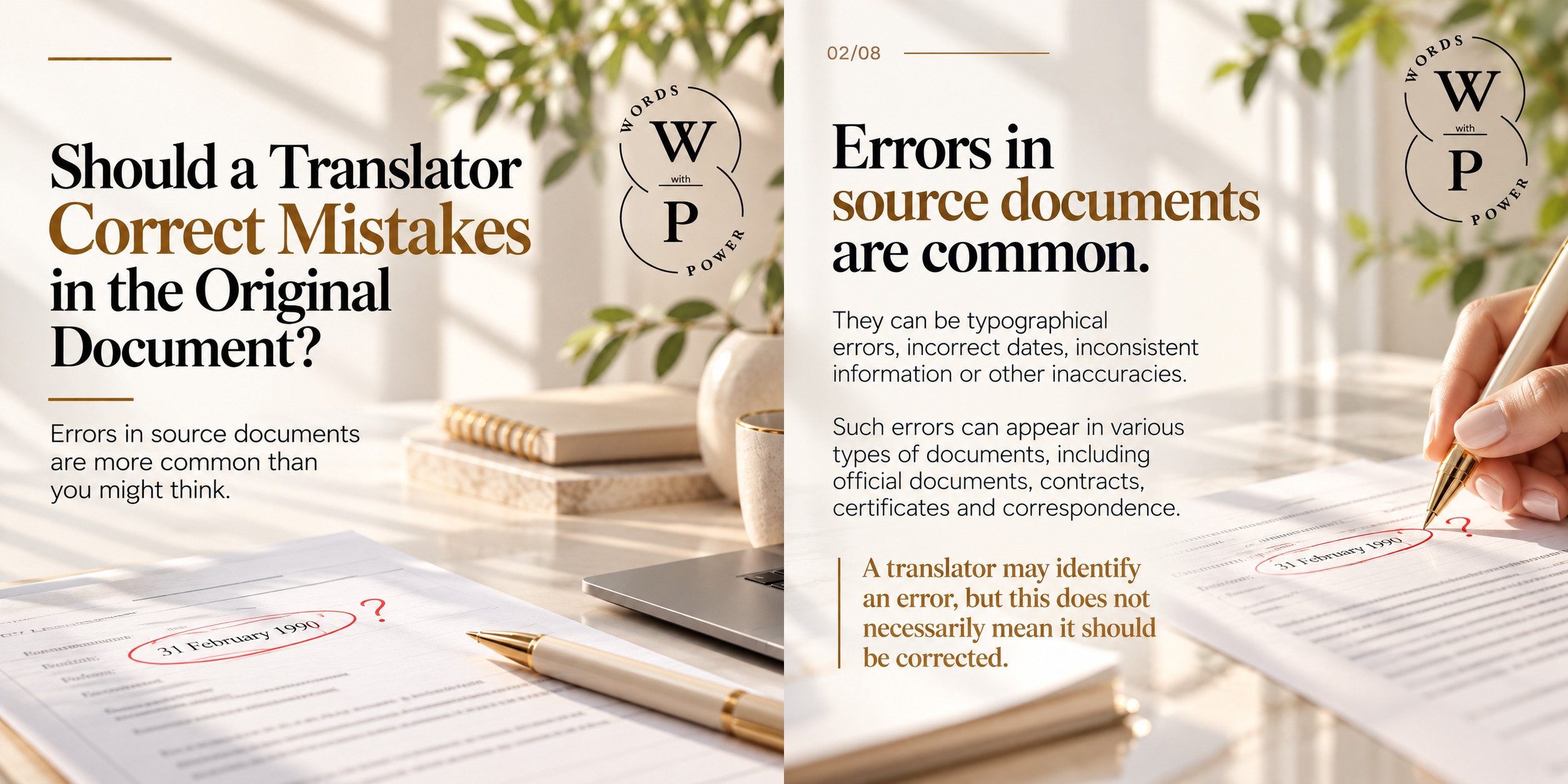
Should a Translator Correct Mistakes in the Original Document?
Errors in source documents are more common than you might think.
Errors in source documents are common.
They can be typographical errors, incorrect dates, inconsistent information or other inaccuracies.
Such errors can appear in various types of documents, including official documents, contracts, certificates and correspondence.
A translator may identify an error, but this does not necessarily mean it should be corrected.
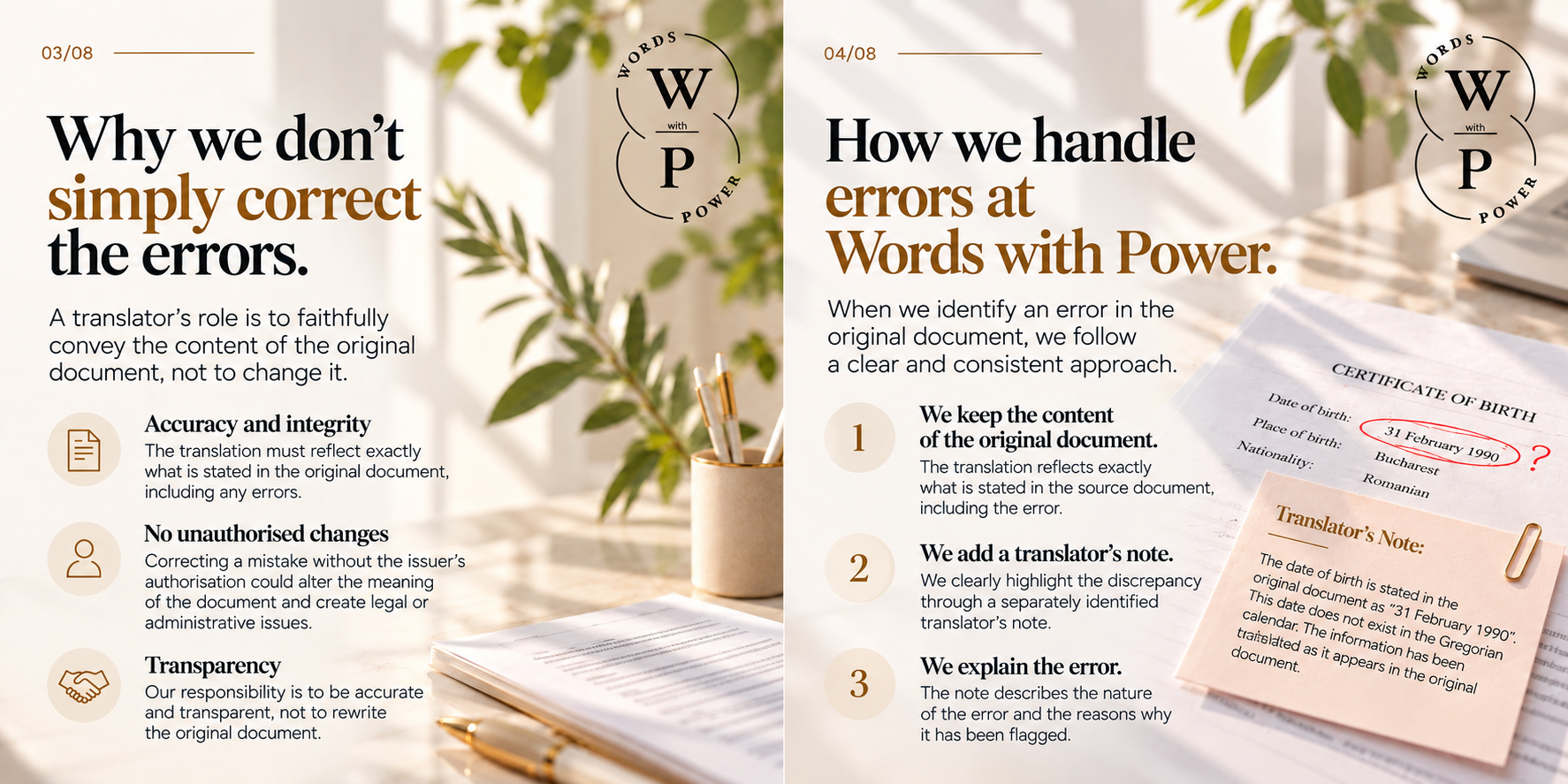
Why we don’t simply correct the errors.
A translator’s role is to faithfully convey the content of the original document, not to change it.
Accuracy and integrity
The translation must reflect exactly what is stated in the original document, including any errors.
No unauthorised changes
Correcting a mistake without the issuer’s authorisation could alter the meaning of the document and create legal or administrative issues.
Transparency
Our responsibility is to be accurate and transparent, not to rewrite the original document.
How we handle errors at Words with Power.
When we identify an error in the original document, we follow a clear and consistent approach.
1. We keep the content of the original document.
The translation reflects exactly what is stated in the source document, including the error.
2. We add a translator’s note.
We clearly highlight the discrepancy through a separately identified translator’s note.
3. We explain the error.
The note describes the nature of the error and the reasons why it has been flagged.
Translator’s Note:
The date of birth is stated in the original document as “31 February 1990”. This date does not exist in the Gregorian calendar. The information has been translated as it appears in the original document.
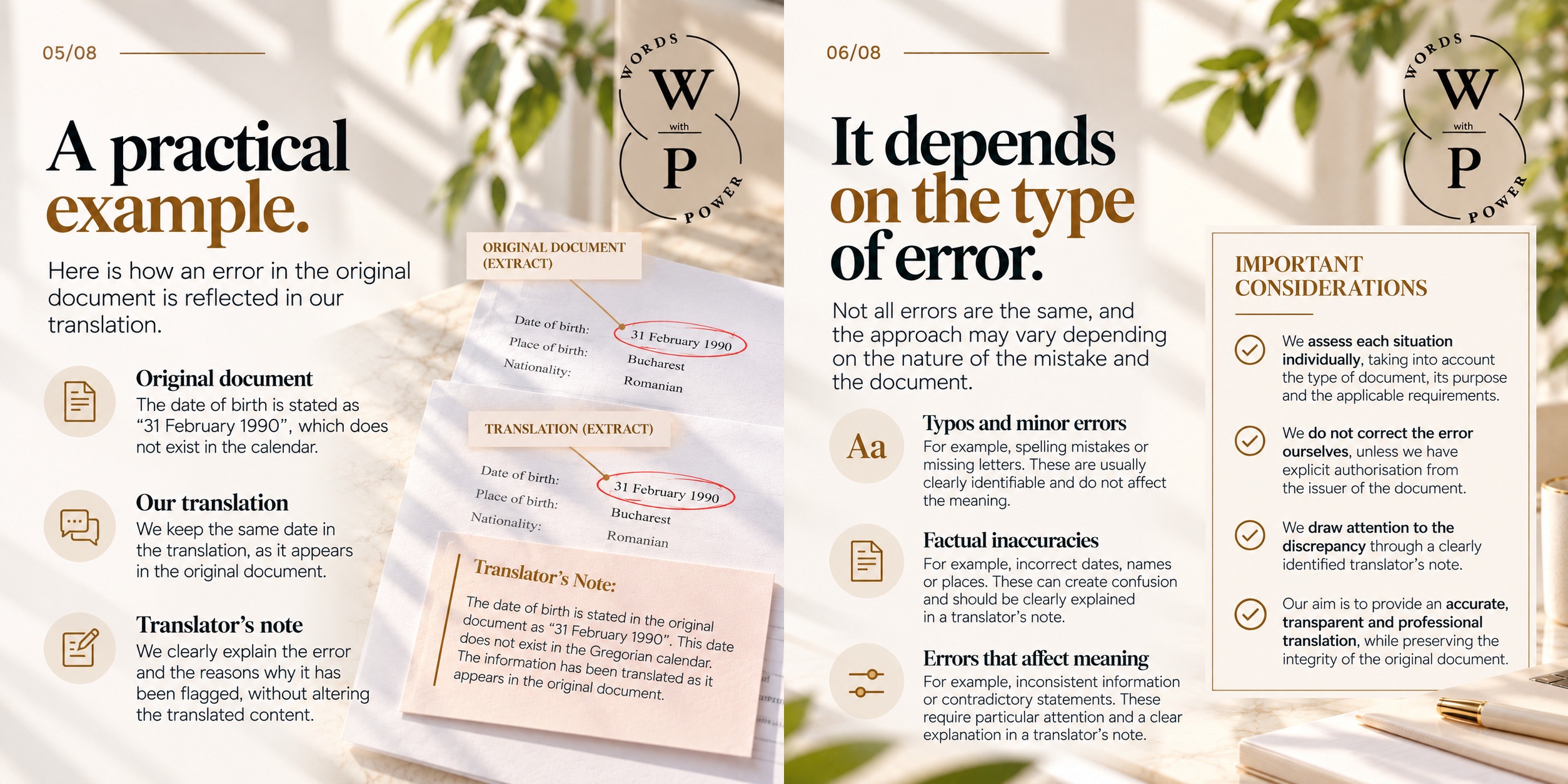
A practical example.
Here is how an error in the original document is reflected in our translation.
Original document
The date of birth is stated as “31 February 1990”, which does not exist in the calendar.
Our translation
We keep the same date in the translation, as it appears in the original document.
Translator’s note
We clearly explain the error and the reasons why it has been flagged, without altering the translated content.
ORIGINAL DOCUMENT (EXTRACT)
Date of birth: 31 February 1990
Place of birth: Bucharest
Nationality: Romanian
TRANSLATION (EXTRACT)
Date of birth: 31 February 1990
Place of birth: Bucharest
Nationality: Romanian
Translator’s Note:
The date of birth is stated in the original document as “31 February 1990”. This date does not exist in the Gregorian calendar. The information has been translated as it appears in the original document.
It depends on the type of error.
Not all errors are the same, and the approach may vary depending on the nature of the mistake and the document.
Typos and minor errors
For example, spelling mistakes or missing letters. These are usually clearly identifiable and do not affect the meaning.
Factual inaccuracies
For example, incorrect dates, names or places. These can create confusion and should be clearly explained in a translator’s note.
Errors that affect meaning
For example, inconsistent information or contradictory statements. These require particular attention and a clear explanation in a translator’s note.
IMPORTANT CONSIDERATIONS
- We assess each situation individually, taking into account the type of document, its purpose and the applicable requirements.
- We do not correct the error ourselves, unless we have explicit authorisation from the issuer of the document.
- We draw attention to the discrepancy through a clearly identified translator’s note.
- Our aim is to provide an accurate, transparent and professional translation, while preserving the integrity of the original document.
Why this approach matters.
Flagging errors through a translator’s note helps ensure accuracy, transparency and trust, both for you and for the end users of the translation.
Protects the integrity of the original document
The translation remains a true and complete reflection of what is stated in the source document.
Provides clarity
The translator’s note explains the discrepancy, helping you and other readers understand the context.
Reduces the risk of misunderstandings
A clear note can prevent confusion and avoid potential issues in legal, administrative or official procedures.
KEY TAKEAWAYS
1. A translator may identify errors in the original document.
2. Identifying an error does not necessarily mean it should be corrected.
3. At Words with Power, we preserve the content of the original and include a clearly identified translator’s note.
4. This approach supports an accurate, transparent and professional translation service.
We don’t change the original. We make the discrepancy visible.
Our commitment to you.
At Words with Power, we combine linguistic expertise with professional responsibility and attention to detail.
Accuracy
We translate with precision and fidelity to the original.
Transparency
We clearly highlight any errors in the original document through a detailed translator’s note.
Professionalism
We provide reliable translations you can trust, while preserving the integrity of the original document.
Same document. Greater clarity.
Thank you for trusting Words with Power.